Hen was sacrificed to let his stablemate win the Hambletonian, then sold to Europe in anger. There he became arguably the most successful US trotter imported to Europe, but is now largely forgotten. The story of Muscletone is the story of the moral Hambletonian-winner as well as the most superior winner in the Prix d’Amerique ever – so superior the French actually ended up changing the rules.
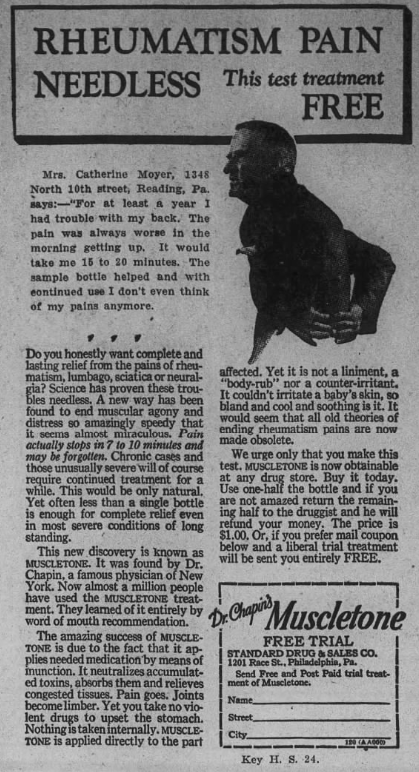
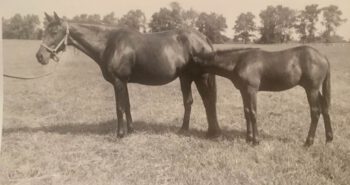
At the Coldstream, formerly McGrathiana, farm in Kentucky, Charles B Shaffer had by the early 30s switched from trotters to runners though he kept two trotting broodmares from the family of Ruth Mainsheet for sentimental reasons. Shaffer had bought Ruth Mainsheet from her breeders, WL (“Farmer”) Spears, when her career had ended after just one start into her three-year-old season. At two she was one of the better horses in her crop and took a record of 2:08 1/4 (1.19,7), a very strong time back in 1917. Her daughter Ruth M Chenault, by Peter Chenault, was outstanding at two and undefeated in the junior futurities in 1926. Her seasonal earnings of $37,337.50 was, in fact, a record for two-year-olds for 22 years until beaten by Miss Tilly in 1948. In 1929 Ruth Mainsheet delivered a colt by Mr McElwyn, Main McElwyn 2, 2:02 3/4 (1.16,3), who proved to be an outstanding trotter in the same mould as his older sister. Both won the Junior Kentucky Futurity at two and showed abundance of speed and natural talent. When the time came to breed Ruth M Chenault, Shaffer settled on the obvious choice, Mr McElwyn. Born in 1931, the brown colt was named Muscletone. It’s easy to suspect the name was based on the horse’s appearance or some generic name, but far from it: Muscletone was a running ad for his owner, quite literally. Breeder and owner Shaffer was also the owner of a remedy for “muscular pains, muscular lumbago and sore and strained muscles” put out by the Standard Drug and Sales Co of Philadelphia which he called “Muscletone” – it’s full name being “Dr Chopins’ Muscletone”.
Like his maternal pedigree promised, the colt had plenty of early speed. Trained by HM “Doc” Parshall, Muscletone showed exceptional talent early and was clocked in 2:39 (1.38,9) in April as a two-year-old with a quarter in 34 1/2 (1.25,8). Despite obvious talent, Muscletone was still a bit immature, and Parshall was also a bit conservative, so on his debut at Salem on Jul 28, 1933 he “only” finished second to Bertha C Hanover. These two would continue to duel through the season. Bertha C again got the better of the colt two weeks later, again at Salem, but Muscletone won one of the three heats in 2:06 3/4 (1.18,8). After losing to Sturdy at the Good Time Stake, he then shaved a second off his record when winning the futurity at Springfield in late August. Though already good, Muscletone appeared to improve throughout the season. Come September he was excellent and easily took home the Junior Kentucky Futurity in two heats straight heats in 2:05 3/4 and 2:06 1/4 (1.18,2 and 1.18,5). On Sept 22 he ran a time trial in 2:03 3/4 (1.16,9) which wound up the 1933 record for two-year-olds. Though seen by many as the most talented in the crop, results-wise he was not the best, though. That honor clearly belongs to the now completely forgotten Sturdy who won 11 out of 12 races at two, but since had not been kept eligible to the Hambletonian was sold to Germany that November. In the final days of WWII in May 1945, Sturdy was one of the horses, alongside Walter Dear and others, taken from Charley Mills’ farm near Berlin never to be seen again.
A winter favorite
When the list of Hambletonian eligibles were released at the beginning of 1934 there was consensus that the early favorites were Bertha C Hanover, Muscletone and Lord Jim. Though Muscletone had been the strongest at the end of their two-year-old season, Bertha C had been very consistent and many believed she had more talent – and would accomplish even more – than her full-sister Hanover’s Bertha. This was supported by Bertha C having shown both a faster quarter and mile than her famous older sister at 2.
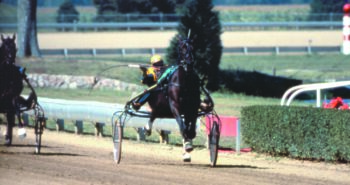
Muscletone started the 1934 season perfectly with easy two-heat win at North Randall and made it two for two at the Cleveland track when he won the Championship Stallion Stake ahead of Reynolda and Emily Stokes. In the Championship Stallion Stake it had been relatively easy sailing for the Mr Mcelwyn colt as no sons of Guy Axworthy or Peter Volo had been nominated due to a conflict between Walnut Hall Farm and the organizer, but when the Grand Circuit moved to Toronto several of the tougher competitors were back. It didn’t matter, though, as Muscletone swept home in three straight heats and set a new Canadian record of 2:03 1/2 (1.16,8) for three-year-old trotters in the second heat. The stiffest competition was female, though not Bertha C Hanover, as expected, but rather Egan’s Princess Peg who finished in second place.
Many now believed the Hambletonian to be a foregone conclusion, but not Muscletone’s trainer, “Doc” Parshall, who had even more faith in Lord Jim. Before the ’34 Hambletonian, he raced him against older horses at Rockingham Park in New Hampshire. He didn’t win, but Doc had a plan by racing him against older horses and was pleased with Lord Jim’s efforts. After the race, a horseman said that Lord Jim didn’t look too good that day. Parshall replied, “Don’t worry, I’m going to win the Hambletonian with this pot-bellied son-of-a-bitch.”
A horse with quirks
Muscletone appeared unbeatable in the eyes of many, kind of like an unsinkable Titanic. But just as Titanic could sink, so could Muscletone lose. A month ahead of the Hambletonian he finished fourth in the Matron behind Emily Stokes, Reynolda and Fay Mack.
Just three weeks prior to the Hambletonian he started showing weakness and inconsistencies. He started to be inconsistent, more fickle and made breaks when pressured. He lost to Reynola, then just a week prior to the Hambletonian Emily Stokes made herself favorite for the Goshen classic when she won he National Stake while Muscletone was disappointing. Nobody doubted Muscletone’s abilities but there was something not quite right with the colt, despite Parshall experimenting with rigging and shoeing. He also seemed to be very one-dimensional: if he couldn’t race in front he didn’t appear game in many races.
The sacrifice
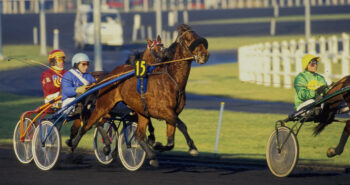
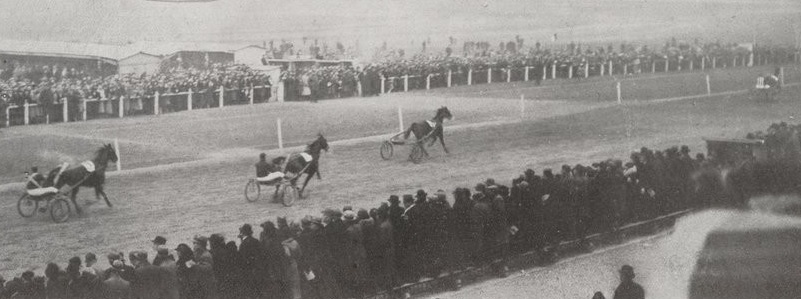
In the first heat of the Hambletonian, Princess Peg won the first heat in 2:03 1/2 (1.16,8) with Vitamine and Will Caton second, Muscletone and Daryl Parshall third, while Lord Jim and “Doc” Parshall finished fourth. In the second heat, Lord Jim prevailed ahead of Princess Peg, Muscletone and Vitamine, winning in 2:02 3/4 (1.16,3). Parshall really wanted to win a Hambletonian but Egan’s Princess Peg was a tough nut to crack. The inventive Parshall came up with a winning strategy ahead of the third heat, though it was certainly a bit dodgy. He knew stood an excellent chance if he had two of the three horses in a final race-off – and had two horses to play out against the impressive Princess Peg.
Parshall quickly came up with a plan how to pretty much guarantee Muscletone, driven by his brother and first trainer Daryl, the win in the third heat. Doc went to Daryl and said, “All the other drivers will be watching Lord Jim this year. I’m going to leave fast with him and get to the front. Then you come on with Muscletone. And when you come, you just keep coming and keep going once you get to the front.” Lo and behold, that is what happened. Lord Jim got to the front and Mucletone came up outside and overook him. Then Doc Parshall began easing Lord Jim back. He just tightened the reins a bit and slowed Lord Jim and slowed the others behind him. Meanwhile, Muscletone was flying on the lead. By the time the other drivers realized what was happening, Muscletone had a 10-length lead and they couldn’t catch him.
The fourth and final heat, the race-off, was clearly unfair to Fred Egan and Princess Peg who was up against two Parshall horses. For reasons impossible to figure out, Parshall chose to sacrifice Muscletone. It appears Muscletone had more potential and was a better horse on a good day, while Lord Jim was a more consistent performer and trustworthy from a driver’s perspective. Not surprisingly, the Parshall brothers with the two colts worked the Egan filly over. Letting Princess Peg take the lead with Lord Jim comfortably at her back, Muscletone pressed the filly hard the first half until he tired a bit and Daryl pulled him back only for Lord Jim to take over over. An exhausted Princess Peg broke in the final stretch while Lord Jim and Muscletone finished 1-2, the winning time 2:04 1/2 (1.17,4). Even though Muscletone was tired after being sacrificed he was by no means beaten, and only lost by three-quarters of a length to Lord Jim – a clear indictation that he was the better horse.
More setbacks
The Horseman Futurity proved another setback as Muscletone set the pace but broke and had to see Vitamine win both heats while he finished last. The Grand Circuit finals at Springfield didn’t give the fast colt any revenge either, as Doc drove Lord Jim to a comfortable victory while Daryl and Muscletone had to settle for second in both heats.
In the Kentucky Futurity, Princess Peg got her revenge on Parshall’s colts after a tough four-heat battle. With the race-off between Princess Peg, driven by Palin who deputized for Egan, Lord Jim and Will Caton’s Vitamine, Parshall couldn’t use two horses to gang up on another. Muscletone had shown speed and had taken the lead in every heat but was both inconsistent and also broke stride in one heat. The winner Princess Peg was a younger sister to Protector and The Marchioness, the latter had been star 3-year-olds for Will Caton just a few years prior: this win meant Margaret Arion had produced three Kentucky Futurity winners in four years! After the race Princess Peg was sold to Walnut Hall Farm and has left a great legacy as a broodmare, she’s the fifth dam of Valley Victory for example. Vitamine, who had been second to Muscletone in the junior futurity, finished second this time around, too, while Parshall and Lord Jim had to settle for third-place.
It wasn’t without a fair share of drama, though: Egan had driven Emily Stokes and in the third heat Egan had sideswept Lord Jim when his filly broke. Parshall had lodged a complaint which the judges eventually dismissed. It seems there was quite a bit of bad blood between the two drivers, though. In the 1933 Kentucky Junior Futurity Egan, driving Emily Stokes, was fined $50 for striking Parshall – behind Muscletone – with the whip. And not surprisingly, Parshall had invited Egan to “dance” by dangerously cutting right in front of him and taking away her chance to win.
Sold in anger
A week later Muscletone ran against the clock in 2:02 1/4 (1.16,0) and it was announced that he was to be retired to stud at Coldstream Farms in Lexington. A short while later, on Nov 19, it was announced that the horse was sold to Italy. Later it emerged the sale price was a measly $5,000, a lot of money at that time but an amount that, as it turned out, the Italian buyer Arturo Riva would recoup after just a few months. The sale was motivated by two factors: Muscletone had a dwindling reputation toward his 3-year-old campaign and it was unlikely he would attract a lot of interesting mares as a stallion. However Shaffer was also upset at how his fine colt had been sacrificed by Parshall and wanted to move the colt on. The irritated Shaffer also switched trainers for Muscletone’s younger sister, Ruth M Mac, who was sent to Hunter C Moody.
The perfect pair
Parshall was undoubtedly a great trainer but he couldn’t totally figure out Muscletone. When the Mr McElwyn-son crossed the Atlantic, however, he wound up in the hands of somebody who was a perfect fit for him: the Russian-born Alexander Finn. Less than 20 years earlier Finn had fled Russia together with 10 trotters in a daring escape where he had been very close to being killed by the Bolsheviks. Through Istanbul he had wound up in San Siro and revolutionized the training of Italian trotters. In an illustrious career that included six Prix d’Amerique wins, Muscletone was undoubtedly the icing on the cake. Legend has it that when Muscletone arrived in Italy he was in poor condition after a troubled trip at sea, so much so that Finn exclaimed at the first meeting: “That’s not a horse, that’s a goat”. But when the Russian started training the American-born colt he immediately realized that this was the best horse he had ever sat behind.
On his Italian debut, in Milan on December 23, 1934, in the Premio d’Inverno, the Winter Prize, he won comfortably and when he repeated in even more impressive fashion two weeks later, also in Milan, Finn decided to take his horse to the French promised land. The jungle telegraph was hard at work and the French knew yet another top foreign trotter was arriving for their big race. Yet, when the horse arrived at Vincennes the French raised their eyebrows in disbelief. They had heard rumors of a “super trotter”, but Muscletone was just a tiny thing. Small, very elegant, almost frail in appearance, though with a natural, fluid gait, Muscletone was not like any typical French trotter. In their eyes, a trotter needed strength and solidity to master the demanding Vincennes track, which was much more demanding and slower back then. Even the Italian press were a bit unsure how their new trotter would do and declared Hazleton the favorite.
Humiliating the opposition
However, after 3 minutes and 38 seconds of racing at Vincennes all critics shut up – and they never dared to say a single negative word about Muscletone ever again.
There will in international trotting never again be a display of superiority like Muscletone in the 1935 Prix d’Amerique.
Granted, it could happen but it seems exceptionally unlikely… Muscletone was not pushed in the confusing start but as the field went past the grandstand for the first time, roughly half a mile into the race, Finn moved Muscletone five-wide around the field and used his speed to take the lead going into the downhill section. In the long, gentle curve after the downhill he moved further and further away from the field. At the top of the uphill the margin had increased to over 15 lengths and down the final stretch he turned the biggest race for aged trotters in the world into a farce. The winning margin was estimated to 30 lengths. To compound the misery for the French, two other Italian US-imports came next: Calumet Guy and Hazleton. The Austrian Nervus Rerum, whose pedigree is 7/8 American, came fourth while Amazone B had the “pleasure” of being the best French trotter in fifth place – although the aging queen could be excused, at 11 she still held her own reasonably well.
Muscletone, to date one of only two four-year-olds to win the Prix d’Amerique, had astounded everybody. Winning was one thing but the manner in which he did it was another. The victory was also yet another foreign win in the Prix d’Amerique, something which hurt French pride. Instead of wanting more foreign blood in their trotters, Muscletone’s win was one of the final nails in the coffin that two years later led the French to close their stud-book to foreign trotters.
It wasn’t only the European trotting public that was impressed. The American public had been skeptical of his move, and John Hervey summed it up rather well in the Harness Horse on March 10, 1937: “When Muscletone arrived on the other side, some two years ago, it was a subject of speculation as just how he might turn out there. In this country he had been a brilliant two-year-old and a brilliant but on the whole disappointing three-year-old. In the opinion of many good judges he was the fastest trotter of his age before the public; in his races he showed bursts of speed that were thrilling. But he became very unsteady, making wild and disastrous breaks in race after race and being beaten almost solely on that account. Something seemed “out of kelter” with the colt. He appeared to be trotting under a strain and all the while in difficulties, carrying himself in that touch-and-go way which signifies that a trotter is not, to use an old expression, “oily,” but, on the other hand, is just on the verge of an explosion. And so it was with him. He would take a superb burst of speed and mow down his opponents – and then “jump up” and fade away in the most disappointing manner. In explanation, it was stated that it had been found impossible to balance him so he would not hit himself behind, and this accounted for his manner of racing. Numerous experiments had been made in his shoeing and balancing, but none of them had overcome his trouble. In consequence he lost caste and after beginning the season in winning form, closed it in disgrace, being unplaced in the Kentucky Futurity, after which he was given a time record of 2:02 (1.15,8) and then sold for export for a bargain price. The announcement of his sale was greeted in many quarters with comment which ran along these lines:
‘So Muscletone’s been sold to go to Europe. What do you think of that? You know he’s a jumping-jack—and over there they’ve got to trot all the way or they can’t win anything. Beside that, he’s a small, light-made colt. He’ll hardly do much the way he’ll have to race in Europe, for they’ll start him over those small tracks, which he won’t like; and then he’ll jump it off and his speed won’t count. Why they ever chose him for Europe is a mystery to me.’
Such were the observations of the experts, as they compared notes. And it may be said that practically nobody among them was prepared for the sequel. Which, as all the world knows, was the greatest career that has yet been recorded over European trotting tracks.”
The Mohammad Ali of European trotting
Muscletone generally cleaned house and when he lost it was usually only when he was so severely handicapped that it just became impossible to win. Later that year, at the German race Matadoren-Rennen, at that time the second biggest race in Europe behind the Prix d’Amerique, he was given a 20 meter handicap – and responded by winning in a new European record 1.16,9 (2:03.4). It was, naturally also a race record which stood until 1970 (!) Back in Cesena, Italy he lowered his European record to 1.16,7 (2:03.2) in the Campionato Europeo. The track record set that day stood for 24 years.
He had a disappointing winter meeting in 1936 as he “only” finished second in the Prix d’Amerique, to Javari, and Prix d’Italie, to Net Worth, but the colt was sick and shouldn’t have started at all. He would come back in terrifying fashion, however. On Oct 11 that year he lowered the European record when he trotted 1.13,2 (1:57.4) in a kilometer-long (5/8 mile) time trial at the fast Le Croise-Laroche in France. This was substantially faster than what Sam Williams had done at Ruhleben in Berlin six years earlier.
In the 1937 winter meeting at Vincennes, Muscletone again dominated, winning the Prix d’Amerique, Prix de Copenhague, Prix d’Italie and Prix d’Belgique, which back then was, unlike now, raced a few weeks after the Prix d’Amerique. To beat Muscletone in the period 1935 to 1937 was generally impossible and it didn’t matter what kind of track, surface, distance, weather or post position he was given. Muscletone lost some times in Europe because he was raced while sick, and a few more because the handicap given was simply too demanding, but he never lost because somebody else had more ability. All the issues Muscletone had in the US with Parshall, however, were gone – under Finn’s regime he was like a Mike Tyson or Mohammad Ali at their best, a freak that simply couldn’t be beat. There have been other US imports with great success in Europe but when looking at the wide array of races, racetracks, distances etc., no US import has been as successful than Muscletone.
Chickening out
But as the trotter, first owned by Riva then by the Milanese businessman Giovanni Maiani, kept racking up wins and accolades in Europe there was still an obstacle to the Italians declaring Muscletone the best trotter in the world – and that obstacle was of course the one year younger Greyhound.
In early June 1937 it was announced that discussions were underway for a match race between the best of the US and the best of Europe. Negotiations continued and on Sep 4 it was finally announced that financial arrangements for the race had been completed. It would be a match race between the best of each world. The duel would be a one-heat, mile and one-half race on October 8 with a purse of $40,000 and side bets of $10,000 by each owner. Before a race in Berlin shortly thereafter, however, Muscletone supposedly went lame and had to be withdrawn. The owners then decided to withdraw him from the match race as well. According to journalists the actual story was a little bit different from the official version: Muscletone’s owner Maiani hadn’t actually seen Greyhound race prior to agreeing to the match-race. When he finally saw the gray gelding tear up the track he realized his freak would be up against another freak – and quite possibly an even bigger freak. According to commonly accepted speculation, Maiani conveniently claimed his star was injured to avoid possibly losing face. However, make no mistake about it: Muscletone had improved massively under Finn. European tracks were at this time considerably slower than North American tracks and a 2:02.4f win in Europe was surely below 2:00 at a fast US track, so the balance of power was nowhere near as uneven as their records could indicate.
In 38 and 39 Muscletone finally started showing some signs of his age and lost some races where he was handicapped. He finished his career with a race in Hamburg on Sep 3, 1939 – two days after the Nazis invaded Poland and started WWII – and had then won 42 in 62 starts in Europe.
Success at stud
He stood stud in Italy and Germany with great success. He sired the great German trio Stella Maris, Miramus and Bammeline, the first two inducted into the German Hall of Fame. Stella Maris, a fortunate survivor of her stable being bombed during the war, won the 1943 German Derby and the 1947 Elite Rennen. Bammeline was one of Stella Maris’ arch-enemies in the years after WWII, and her maternal family lead directly to the German legend Diamond Way. Miramus, out of a daughter of Walter Dear, war was on a farm in East Germany just after the war. The legendary German trainer Johannes Frömming hitched him to a carriage and drove him into West Germany, then put him in a furniture van and took him to Hamburg. Miramus, born 1943, was still young, but Frömming’s belief was proven correct when the trotter won numerous big races highlighted by the 1948 Matadoren-Rennen.
Muscletone’s daughters were also great producers and he is the damsire of four Italian Derby-winners. Muscletone’s sireline is actually still alive in Germany, though on life support with little hope of being extended. With no long-term legacy at stud, Muscletone has largely become forgotten, which is a shame: the stallion was a spectacular sight and, at his best, the definition of superiority on four legs.
Muscletone
Brown colt born in Fayette County, Kentucky in 1931. Died at Quinto Romano, Italy on Aug 23, 1954.
Mr McElwyn – Ruth M Chenault (Peter Chenault)
3, T2:02 (1.15,8)
Breeder: Charles B Shaffer
Owners: Charles B Shaffer, Arturo Riva, Giovanni Maiani
Trainers: HM “Doc” Parshall, Alexander Finn
Drivers: Doc Parshall, Daryl Parshall and Alexander Finn
Groom: –